


 Search
 Close
CloseImprovements to our valuations.
Great news! We’ve improved the valuations delivered through your AutovistaVALUATION API
What’s changed?

We evolved our valuation methodology to bring more market-aligned insights that support strategic planning. These updates ensure your products continue to deliver the precision and reliability you expect.
READ MORE ABOUT OUR VALUATION METHODOLOGY HERE
As part of our broader valuation methodology enhancements, we introduced significant improvements to the AutovistaVALUATION API on 1 December 2025.
These changes provide clearer, more consistent, and more market-responsive data across all valuation products.
Key changes:
1. Legacy Calculation Modes
From 1 December 2025, certain calculation modes – such as Grade, Condition & Sector specific values – are no longer supported. These previously addressed condition-based or sector-specific use cases but have now been replaced to align with our unified, market-responsive methodology.
If you previously used these modes, your systems should now be configured to use the Standard Trade and Standard Retail values.
2. Average Mileage
Mileage corrections are now fully integrated into Glass’s Trade and Retail values, based on real-time market data.
As of 1 December 2025:
- The average mileage parameter is no longer included in the API response.
- If your business still requires average mileage figures, these should be sourced from an external, market-reliable provider.
- Relying on average mileage alone may not capture market dynamics fully, as our methodology now incorporates a broader set of variables for more comprehensive valuations.
3. Basic Residual Value / Mileage Correction
Because the average mileage parameter has been removed, Basic Residual Values and separate Mileage Corrections are no longer provided.
This reflects our move to a dynamic valuation approach where mileage adjustments are already built into the delivered Trade and Retail values.
As a result, standalone “basic valuations” based on assumed mileage and condition are no longer generated.
All API valuations now reflect real-time market data for the most accurate representation of vehicle value.
What to keep in mind
Action required
- Review your integration to ensure it now uses Standard Trade and Standard Retail values.
- Check your dependencies – our FAQ section provides more detail on how these changes may affect your systems.
Support and documentation
If you previously relied on any data fields that are no longer supported, our Integration Team is available to help. Please contact us at customer@autovistagroup.com
We’re confident these improvements will bring significant value to your business. Thank you for your continued partnership.
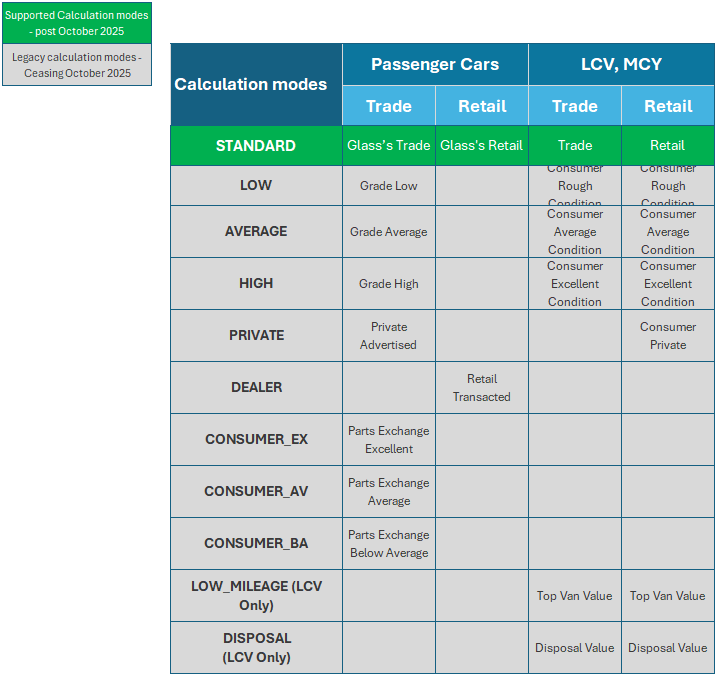
The image shows the API methods supported following the update.
FAQs
- Adjust Standard Trade or Retail values: Apply value-increasing or decreasing factors using your internal pricing logic to account for vehicle condition, repair needs, or other specific considerations.
- Utilise the Valuation Adjustments feature: The API enables you to define adjustments dynamically through “AdjustmentType,” including options such as Vehicle Condition, to tailor valuations effectively.
- Leverage Repair Estimate insights: Repair Estimate can help assess the costs of cosmetic, trim, and Bodyshop repairs, providing a robust foundation for refining valuations. This ensures your pricing stays aligned with market trends and reflects a vehicle’s specific condition. If you’re interested in this feature, please contact our Sales Team.
If you have identified that you are using calculation modes that will no longer be supported, our Integration Team is available to assist with any technical queries you may have. Additionally, detailed technical support documentation for APIs is available to help guide you through any changes. If you need further assistance, please contact our Customer Experience Team at customer@autovistagroup.com, detailing your query, and a member of our team will reach out to support you.
- LOW
- AVERAGE
- HIGH
- PRIVATE
- DEALER
- CONSUMER_EX
- CONSUMER_AV
- CONSUMER_BA
- LOW_MILEAGE (LCV Only)
- “DISPOSAL
- (LCV Only)”
Mileage correction factors will be removed, as exact mileage is now fully integrated into our core valuation methodology. This eliminates the need for additional mileage adjustments, simplifying your processes and ensuring valuations remain accurate.
Our standard Retail value utilising our data AI-driven system, supported by our expert editor team using real time market observational data. This ensures your pricing remains precise, competitive, and aligned with market conditions
Trade valuations will continue to be based on robust market data and refined to provide accurate and reliable insights. This ensures dealers and traders have a dependable foundation for assessing vehicle values and making informed pricing decisions in today’s dynamic market.
We are committed to keeping you informed as we roll out these improvements. You will receive regular updates about specific product changes, ensuring you’re always up to date on key adjustments and new features. These updates will be sent to you over the course of the next several months, with the goal of aligning the changes by 1 December 2025. Rest assured, we’ll provide timely information on how these updates will impact your usage and experience with the product.
We plan to go live with these changes progressively over the coming months, with all updates fully implemented by 1 December 2025. A scheduled maintenance weekend (28–30 November) will support this transition. As we move forward, we’ll keep you informed with regular updates about the specific timelines for each stage of the rollout, so you can stay ahead of any changes affecting your product experience.
Help & Support
 customer@autovistagroup.com